Showing posts with label teaching through pictures. Show all posts

Monday, August 24, 2015

Learning Economics Through Pictures - Uber and Ride-Share restrictions. (Guest post)

This is a guest post by Courtney Conrad.  She is a junior economics major at Susquehanna University and has served as my research assistant since her freshman year. 


While I vacationed in Florida a few times this summer, I noticed new signage popping up all around Orlando International Airport (MCO). As I read the content on the signs, I couldn’t help but think of governmental interference in economic/consumer freedom. These signs, and the policies they promote, threaten fines and even arrest if ride services such as Uber, Lyft, etc. attempt to pick up passengers at MCO.

Being an economics major, I immediately realized the negative implications of such a policy – loss of freedom of choice for the consumer. Since passengers are restricted as to how they can pay to depart the airport, their consumer freedoms are ultimately hindered. With a loss of freedom of choice, and passengers only able to pay for a ride service from permitted ground transportation, this causes a negative ripple effect for people interested in working for ride share operators. If Uber, for example, is limited in the locations they are allowed to offer their service, they will not need to hire drivers to accommodate those “off limits” areas – thus, potential/current Uber drivers’ chances of making a living are potentially stunted due to Uber needing less drivers.

Furthermore, to the naked eye, travelers reading this sign will think MCO has their passengers’ safety and well-being in mind through this action. Admittedly, this is the true case to some extent; but, there are more predominant agendas behind-the-scenes here. The airport claims to have passengers’ safety as their top priority -- however, restricting competition is of the same prioritization and importance (if not more) to MCO in this instance. By infringing on consumer freedoms and limiting airport departure transportation, ground transportation with a permit can charge very expensively for their service(s). The permitted transportation knowingly charges such a high amount since they realize that they are the passengers’ only option and the passengers are practically forced to pay the designated price due to no other ground transport options. Also, by cutting off ride share operators in the area around MCO, the airport profits from the (costly) permitted ground transportation they are associated with and does not lose out to Uber, Lyft, etc. With the benefits MCO and permitted transportation gain while forbidding ride share operators, safety seems far from the main reason for the restriction.


So, to the typical passerby in Orlando International Airport, this sign simply lets them know that their mobile Uber app will not be allowed/applicable in the area. However, to the passionate economics major passing through, this sign does not just mean consumers are losing out on using an app – but freedom, too. 

Sunday, July 12, 2015

Learning Economics Through Pictures - Washing Cloths

Thanks to Dirk Mateer for taking and posting this great picture on his facebook feed!  (And for his permission to use it!)


As Dirk writes:
Check out the photo at the self laundry facility! See the old black and white photo of the women washing and drying by hand above the new stainless machine? Those labor intensive jobs are long gone but society is better off because it takes less time to wash and dry than before.

He's absolutely correct here.  This is a great example of an innovation that displaced labor.  Throughout history, there have been thousands of innovations that have caused tasks to be completed less expensively and with less labor.  At the time, however, those tasks could cause some pain to those who are displaced.

Even today we hear about machines replacing people at tasks (and some previous pictures I've posted have covered that).  In the long run, however, when more is produced using less labor - society is better off!

Thursday, February 5, 2015

Learning economics through pictures - wine prices in Pennsylvania and Arizona

Here's the price tag in Arizona for a 1.5 liter bottle of Gallo Pinot Grigio.  The regular price is $9.99, but it is on sale for $6.99.  


Here is the price tag for the same bottle in Pennsylvania:


That's not all - in Arizona, when you buy six bottles at a time you get a 10% discount!

So without a sale, in Pennsylvania the price is $11.49 and in Arizona the price is $9.99.  With a sale and bulk discounts, it's actually a bigger disparity.  Why such a difference?  Wine is sold through free-markets in Arizona.  But in Pennsylvania the wine stores have a monopoly.  What's even worse is that it is a government-run monopoly, so there is not even a push for efficiency.  A simple step would be for the Pennsylvania government to privatize the liquor industry.

Wednesday, December 31, 2014

Learning Economics Through Pictures - Minimum Wage and Jack-in-the-Box

On a trip to California last week, this is what I found in a Jack-in-the-Box restaurant.  Putting in a machine like this is a natural response by firms who see minimum wage increases (or threats of minimum wage increases).  The firms will replace low-skilled employees with machinery.  

California increased their minimum wage on July 1, 2014 (to $9.00/hour).  That is terrible news for young and low-skill workers.


Thursday, December 11, 2014

Learning economics through pictures - free market innovation

This chart shows the price of a GB of data.


Source here

I don't have much else to say here - except that this type of incredible innovation that has cut the costs so dramatically only happens with free markets.

This raises a good question: Has the price of any government product dropped over time?

Wednesday, December 10, 2014

Learning Economics Through Pictures - NFL Ticket Prices and Demand


This screenshot was taken of stubhub.com.  It shows prices to five different NFL games, all played this past Sunday.

This is a good illustration of how demand for a product affects its price.  These stadiums aren't dramatically different in size - all can hold tens of thousands of customers.  By December, however, some teams are no longer in playoff contention, while others are.  Three teams contending for playoff spots, the Dolphins, Bengals, and Lions, all have minimum ticket prices of about $50 while a fourth, Cleveland, has a minimum price of $31.

The two teams that aren't in playoff contention that are hosting games are the Jaguars and the Redskins.  Their minimum ticket prices are $25 and $6.

With a higher demand and a fixed supply, the price should increase to ensure an equilibrium.  That appears to be happening in the market for sports tickets.

Another note - given that many tickets are purchased months in advance, this equilibrium can only occur when there are legal markets that allow tickets to be resold.

Wednesday, November 12, 2014

Teaching Economics through Pictures - Food Trucks and Price Discrimination

Thanks to Austin Boyle (he's at @austinboyleecon) for posting this on twitter ...


This is a picture of a menu from a food truck.  The key thing to note is how the prices aren't printed on the menu?

The most reasonable explanation for why they're not posted is that firms price discriminate.  When the food trucks go to different locations, some consumers may have higher incomes overall while others have lower incomes.  This will translate into larger or smaller willingness to pay for food products.  By not printing the prices on the menu, food trucks can price discriminate.  What might cost $8 in one part of town will cost $9 or $7 in others.  The firm will change prices in order to maximize profits.

This is a classic example of price discrimination.  The cost to the firm is the same, but different prices are charged to different people based on their willingness to pay.

Saturday, November 8, 2014

Learning economics through pictures - markets vs. voting


There are some who use economic methods to examine issues in political science - this area of work is called Public Choice Theory.

One commonly discussed issue is "the majority rule problem".

An example of this is when a small majority of voters (say 52%) has a slight preference for a particular law while a large minority of voters (48%) has a strong preference against.  In this case, the overall well-being of society will be lower when the law is passed, but we would expect the law to indeed be passed because 52% want the law.

The majority rule problem occurs because each person, regardless of how strongly he/she feels about an issue, only gets one vote.  One vote cannot measure intensity of preferences, it can only measure the direction of preferences.

This is different from markets, where intensity of preferences is measured.  For example, most people would rather have a Mercedes than a Kia, all else equal.  But the price isn't equal.  Those who most want a Mercedes can purchase one - by paying more.  The intensity of their preferences is measured based on willingness to pay.


Saturday, October 4, 2014

Learning economics through pictures - price discrimination and cruising

Price discrimination is the practice of charging different buyers different prices for the same product, even when there are no cost differences.  (Note, the word "discrimination" has a negative connotation but price discrimination can actually improve the well-being of society.  Further, military and senior discounts are forms of price discrimination.)

Here is a picture of cruise pricing on Orbitz.com  All prices are for the same cruise, just different dates.  

This is a classic example of price discrimination.  The cost to the cruise company is the same on for each trip.  The cruise company has to pay the same amount for fuel, materials, and labor.  However, the demand to cruise from December 29-January 2 is considerably higher.  The 4 day stretch around New Years Eve is a popular time to celebrate, many people are off from work and almost all kids are off from school.  Because of this difference in demand, the same four day cruise costs 350% more during peak times than during the off-peak time.

The cruise industry also engages in other forms of price discrimination.  I'll post about those soon.

Friday, September 26, 2014

Learning economics through pictures - law school enrollment and the law of supply

For many years, there has been chatter that the returns to a law degree aren't what they used to be.  (E.g., see this).  Other stories have talked about how tough it is to find a job after graduation.  All of this would indicate that the returns on a law degree are lower than they once were or that the price one earns from being a lawyer has dropped.

Today I saw this chart:


The law of supply states that when the price drops, fewer suppliers will enter a market.  This chart shows that the market for lawyers is consistent with the law of supply.

Link to source article here


Thursday, September 11, 2014

Learning economics through pictures - beer vending machines

Thanks to SU econ major Courtney Conrad for bringing this to my attention!


This is a beer vending machine found in the stadium of the Minnesota Twins.  The benefits of this for the stadium is that you need fewer worker.  The downside, of course, is that the machines cost money.  

With higher minimum wages and threatened future minimum wage increases across the country, however, these types of machines will become more widespread.

Friday, August 15, 2014

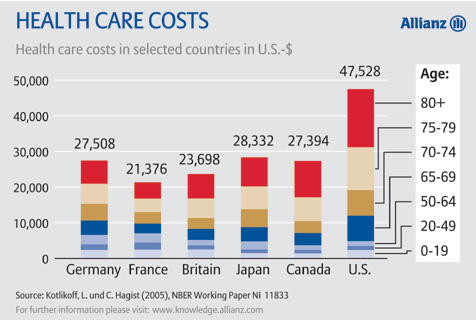
Learning economics through pictures - US medical spending

Picture 1 source here


The conventional story is that the US was horrendously inefficient, much more so than other countries.  While that may be true, these graphs make it appear that it's more likely that we spend far more on elderly care than other countries.  For those under age 60, we don't seem much more inefficient than other countries.  These graphs make it appear that it is not inefficiency, but choices on how much to spend on elder-care, that make our per-capita health care expenses more than other countries.  (Note - these graphs are from pre-Obamacare data.)

Tuesday, June 3, 2014

Learning economics through pictures - diminishing marginal utility "fail"


Hat tip to Susquehanna University student Courtney Conrad.

This picture is a joke (I hope), but it allows us the opportunity to talk about diminishing marginal utility.  This promotion doesn't recognize it.

The idea of diminishing marginal utility is that consumers will value a 2nd item less than the first item.  One good example: What's more important, a family's first car or their second?  It's naturally the first car.  Without the first, the family can't use a car at all.  Going from one to two can be incredibly helpful, as two people can drive at once, but it's not as important as obtaining the first vehicle.  The same concept holds when discussing the first and second pieces of pizza, televisions in a house, and almost all items.  That's why economists call it the law of diminishing marginal utility.

Usually, "buy one, get one 50% off" promotions are done because firms recognize that a 2nd unit is not worth as much to the consumer.  The promotion pictured above doesn't recognize the law of diminishing marginal utility.


Wednesday, May 14, 2014

Learning economics through pictures: correlation does not equal causation

Link to site


I got a chuckle from this.  While I am not a fan of organic foods or the organic foods industry, can anybody really claim that organic foods cause autism?

Unfortunately, on many topics, people do confuse correlation for causation.

Tuesday, February 11, 2014

Learning economics through pictures ... Unintended consequences


The Affordable Care Act (Obamacare) imposed a tax on tanning beds.  Many gym memberships included the ability to use tanning beds.  Planet Fitness posted this sign in one of their stores, to indicate how their users now must pay a tax.

This is a good example of an unintended consequence.  Its pretty clear that battling obesity is a priority from the current White House administration (Michelle Obama has spent a lot of time on this issue).  I'm sure they didn't intend to impose extra costs on gym memberships.  That said, it is difficult to foresee the unintended  negative side-effects from government policies.

Sunday, February 2, 2014

Learning economics through pictures: Inflation-adjusted prices for video game systems

This shows the original (nominal) prices and the inflation-adjusted prices for twenty-four video game systems released since 1977. (Source: randommization.com - HT - Kim Holder)